Five Days in the Chair: The Bridge Starts to Feel Real
Five nights of work in the captain's chair: the ship learns to wheel in three dimensions, the guns trade a cheat-beam for honest steel, and the cockpit finally looks like an instrument I trust.
Dev log
Five nights in the chair. The ship learned to wheel like a cathedral door, the guns stopped cheating, the cockpit got quiet, and the sky finally has a sun in it. Somewhere in the middle of it I stopped feeling like I was building a tech demo and started feeling like I was visiting a place.
What changed in the chair
The first thing a stranger should notice is the weight. Throttle is a commitment now. Push it forward and the bow rolls into a turn the way something a hundred meters long has to: slowly, with conviction, with the stars wheeling past at exactly the pace mass insists on. Full reverse is its own little drama instead of a tap on the brakes. The day I gave the ship six real directions of thrust was the day she stopped sliding around like a hovercraft. Tap a turn and the little side puffs cough out in the right places. Hold throttle and the main drives bloom into a hot core. Watching the kraken pirouette through the asteroid belt with bright maneuvering jets stitching the dark was the first time I felt like I was reading body language off a ship.
I did not get the controls right the first time. For an entire evening I was flying a mirror image of my own ship. Push left, she would lazy-yaw right, and I kept gaslighting myself that it must be the camera. No, it must be the input. No, wait, it must be the chase frame. The fix was three sign flips and a rule I will tattoo on my forehead: never argue with the picture. The picture wins. There is a folder of left-turn and right-turn captures from that night that I look at when I get cocky.
The proudest dead end of the week was a damage system I had cooked up: layered shaders, molten rims, beveled cuts into the bow, the works. It looked beautiful in isolation and it was making every other decision harder. So I tore it out. The whole subsystem, gone, on purpose, no apology. The ship sailed naked for a couple of days while I stared at her clean silhouette and rebuilt the lighting underneath without the damage layer fighting me. It felt awful and it was exactly right. The wounds will come back, but on a foundation that earns them. When they did come back, the armor peeled into a beveled cut with a molten rim, and the ribs of the deck showed through the breach like something with insides worth protecting.
The hitscan placeholder is dead too. I retired the magic instant-zap and put real metal in the air. Heavy slugs that you have to lead. Guided torpedoes that crawl in from long range and that you can actually count. Point defense that pops incoming ordnance into bright sparks and that can be saturated if you throw enough at it. A silencing weapon that takes a ship's teeth out without killing it. The combat read flipped overnight from "two lights touching" to "I have to commit my ship to a firing line and live with it for the next ten seconds." The first time an enemy dove out of my broadside plane to come up at me from below, I laughed out loud. A capital ship does not turn. It commits. And the fight finally agrees.
The most humbling hour of the week was a ghost in the picture I was sure was a precision bug deep in the rendering. I had a hypothesis, a beautiful one, with a story and a culprit and everything. I built the experiment that would prove it, ran it, and the screen calmly told me I was wrong. The bug was somewhere else entirely. There is a particular flavor of late-night quiet when a theory you have been carrying for hours just evaporates on contact with a screenshot. Humbling, and a little freeing.
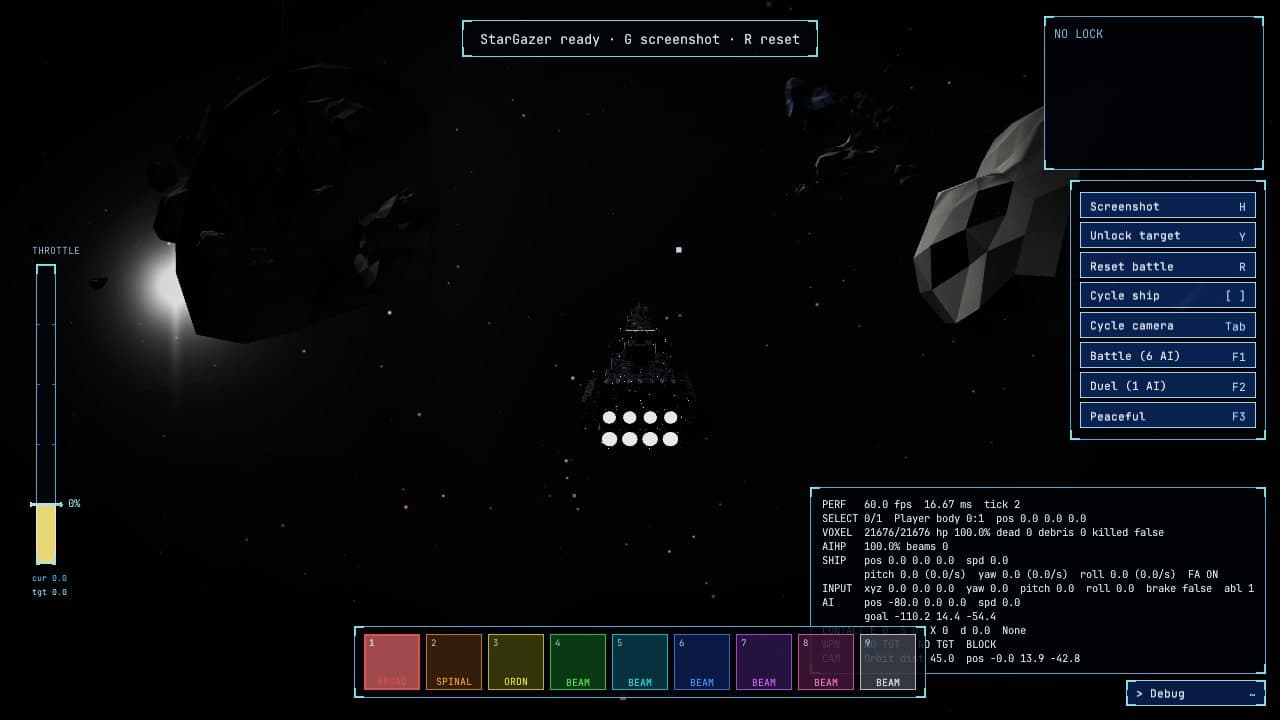
The cockpit got the last edit. The diagnostic clutter that used to crowd the top of the screen folded into a single quiet corner button, ready when I want it, gone when I don't. The bow, the stars, and the lock readout do the talking now. Click an enemy and its capabilities bloom around it as a real three-dimensional lens, so I can see exactly where its teeth are before I commit the turn. The view is finally a window again.
Visual changelog
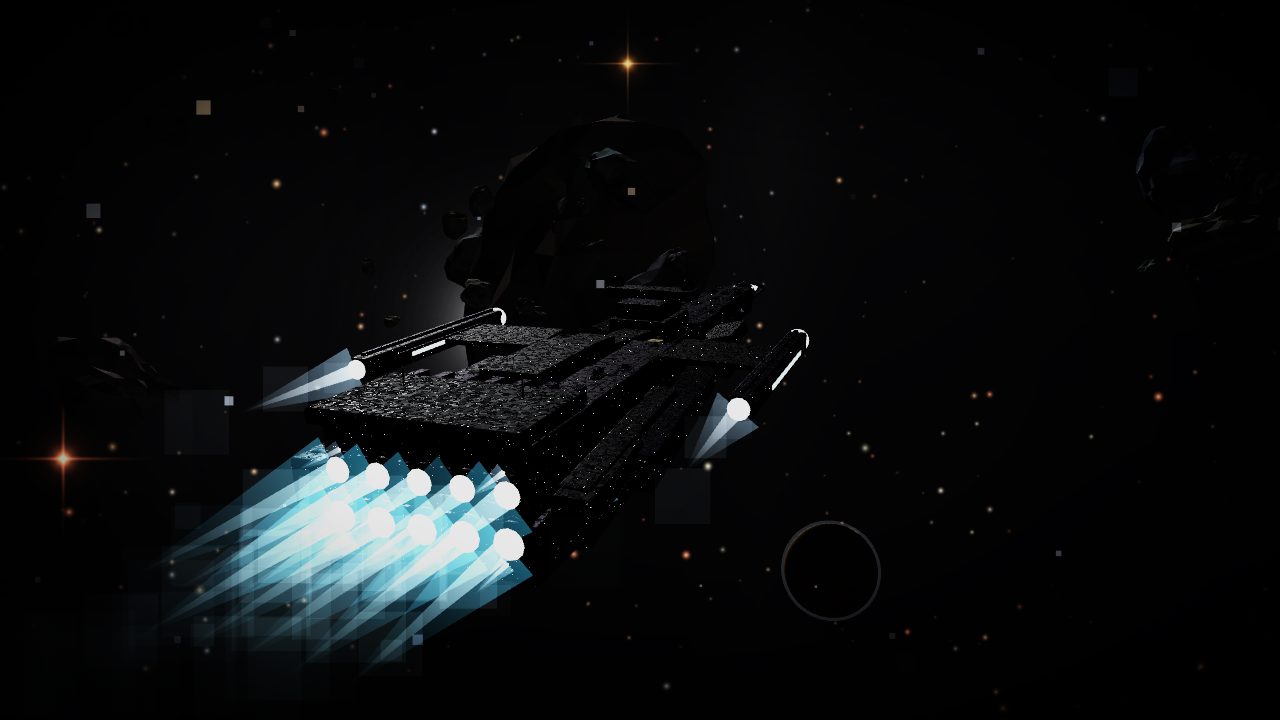 The hero shot. A capital hull lit by its own engines against the cold dark, the picture I keep coming back to when I forget why I started.
The maneuver, in motion. A heavy ship committing to a turn, plumes blooming from the right ribs as it leans into the corner. This is the clip I could not stop replaying.
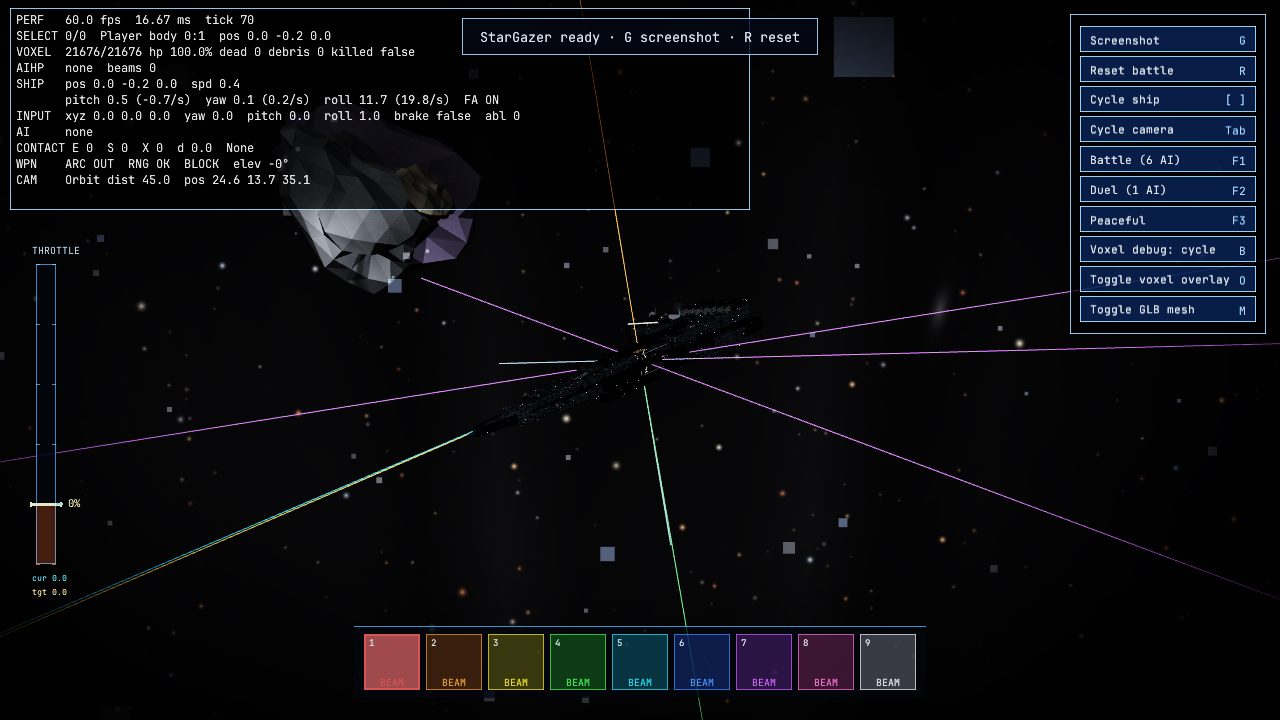 Roll, from behind the chair. The horizon tilts and the stars wheel. The first time it felt like I was in the ship, not steering a token.
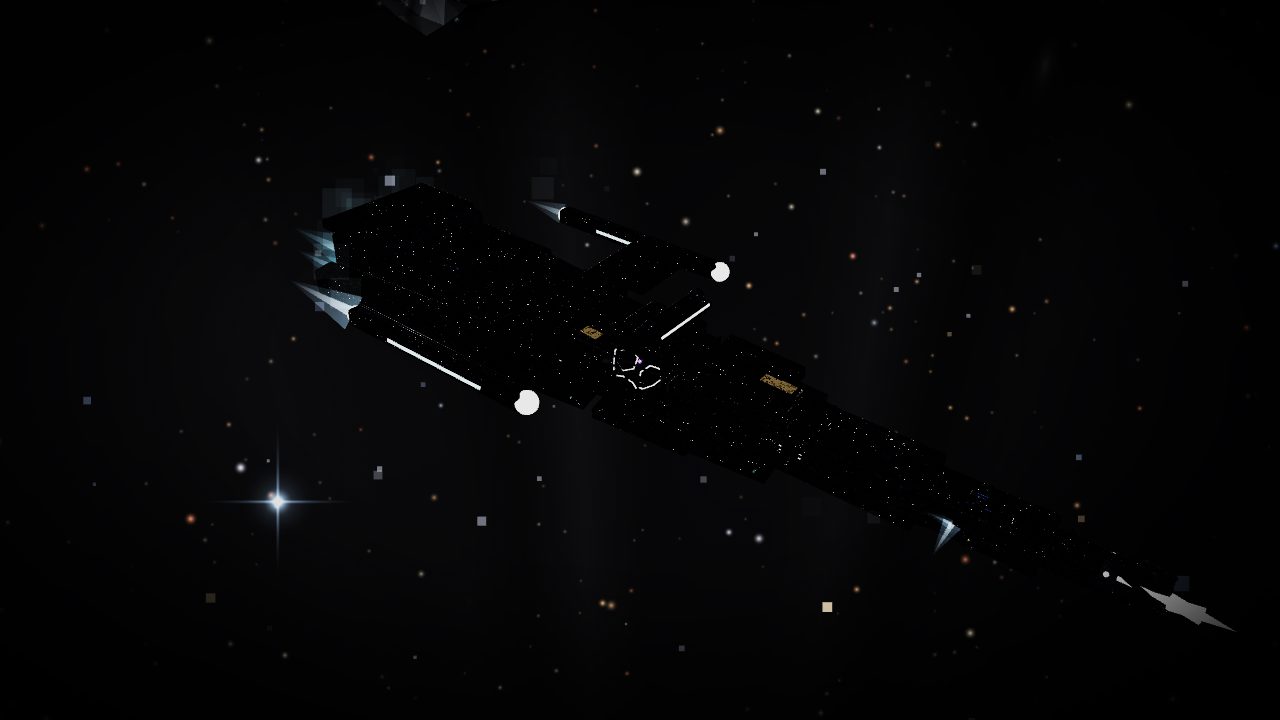 The little jets that sell it. Tiny puffs flickering along the spine as the ship yaws. They are the difference between a vehicle and a vessel.
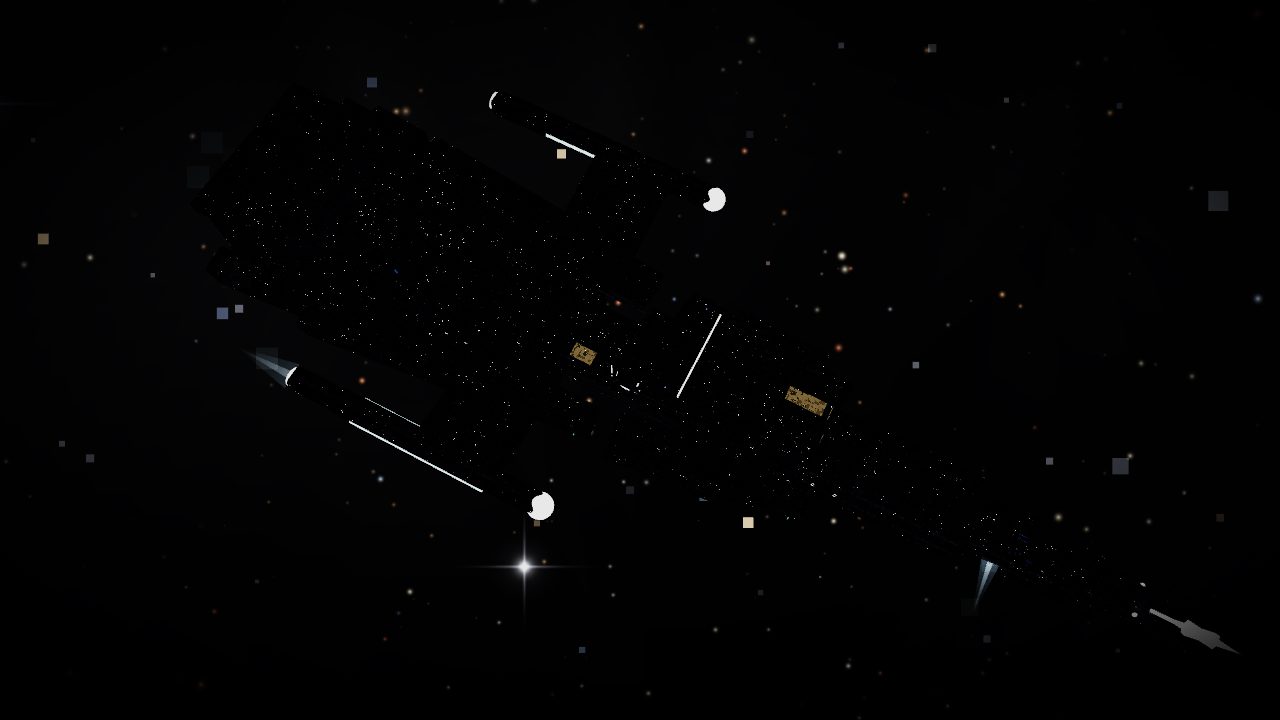 Top-down on a turn. Looking straight down as the bow swings, the firing jets blink in a pattern you can read like sheet music.
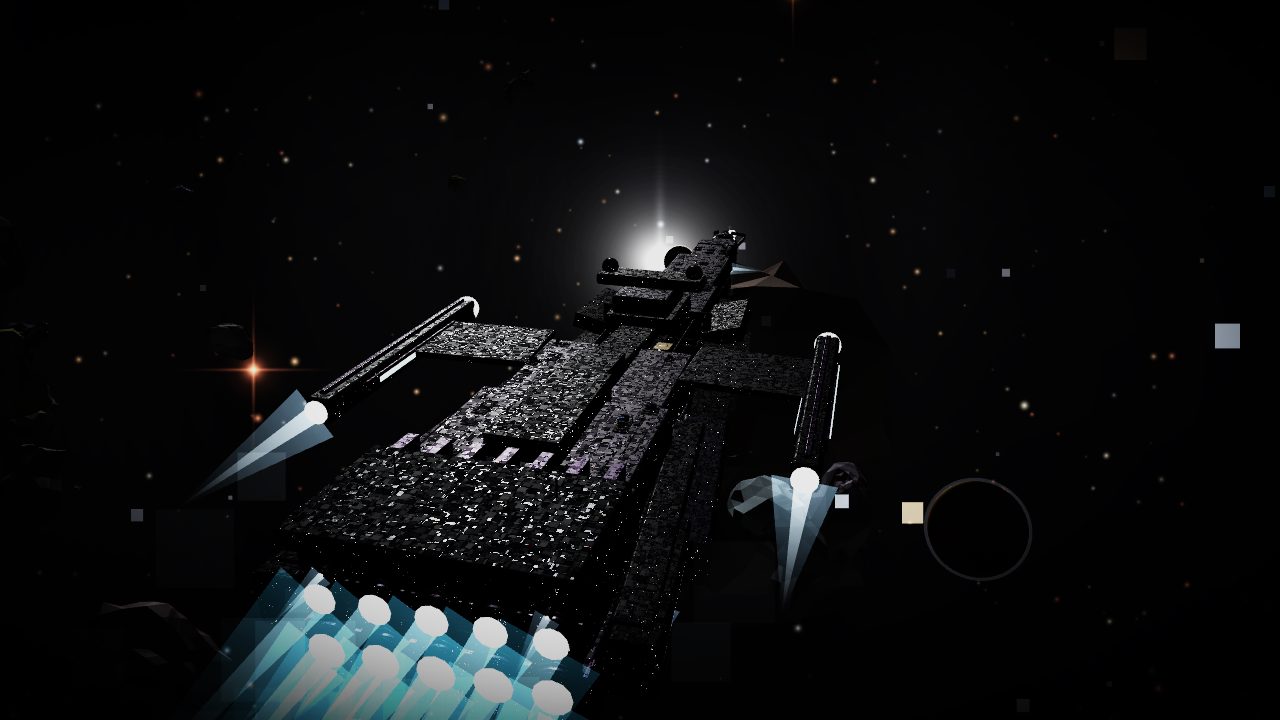 A roll on every axis. Six directions to push, six directions to spin. Flight stopped feeling like a steering wheel and started feeling like swimming.
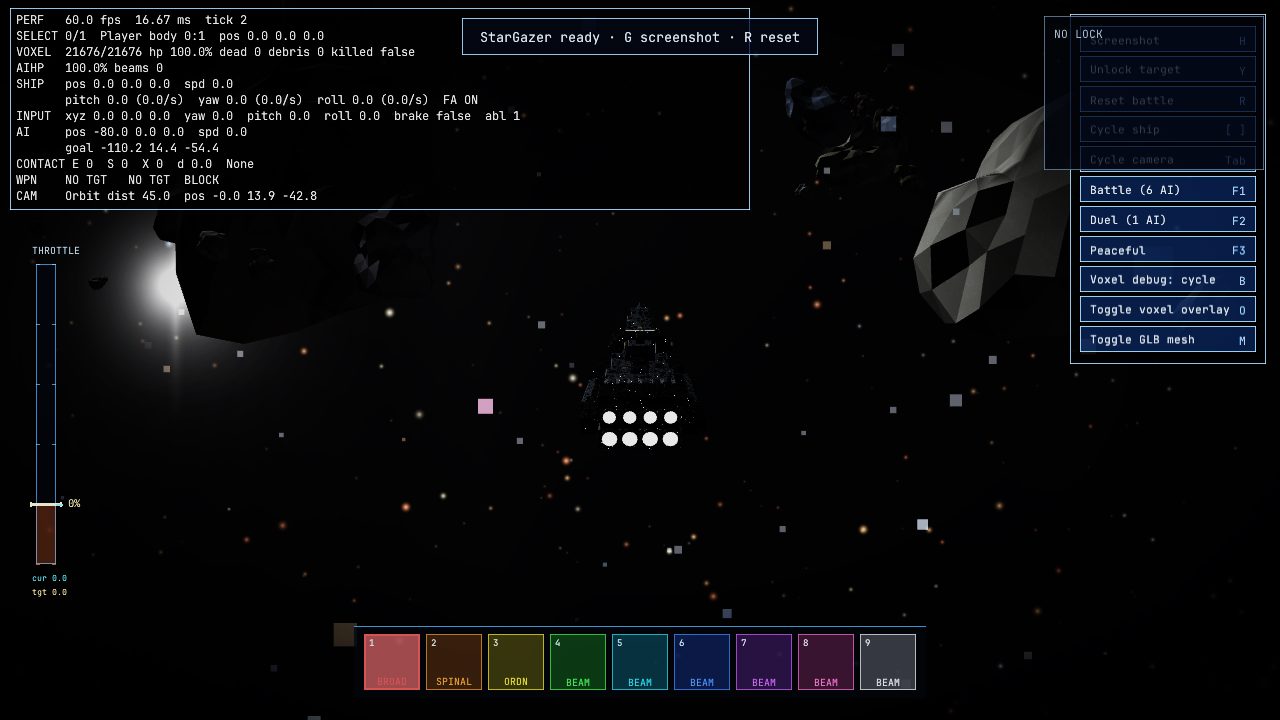 Before. What a ship looked like a week ago, when the only thing in the sky was a black silhouette.
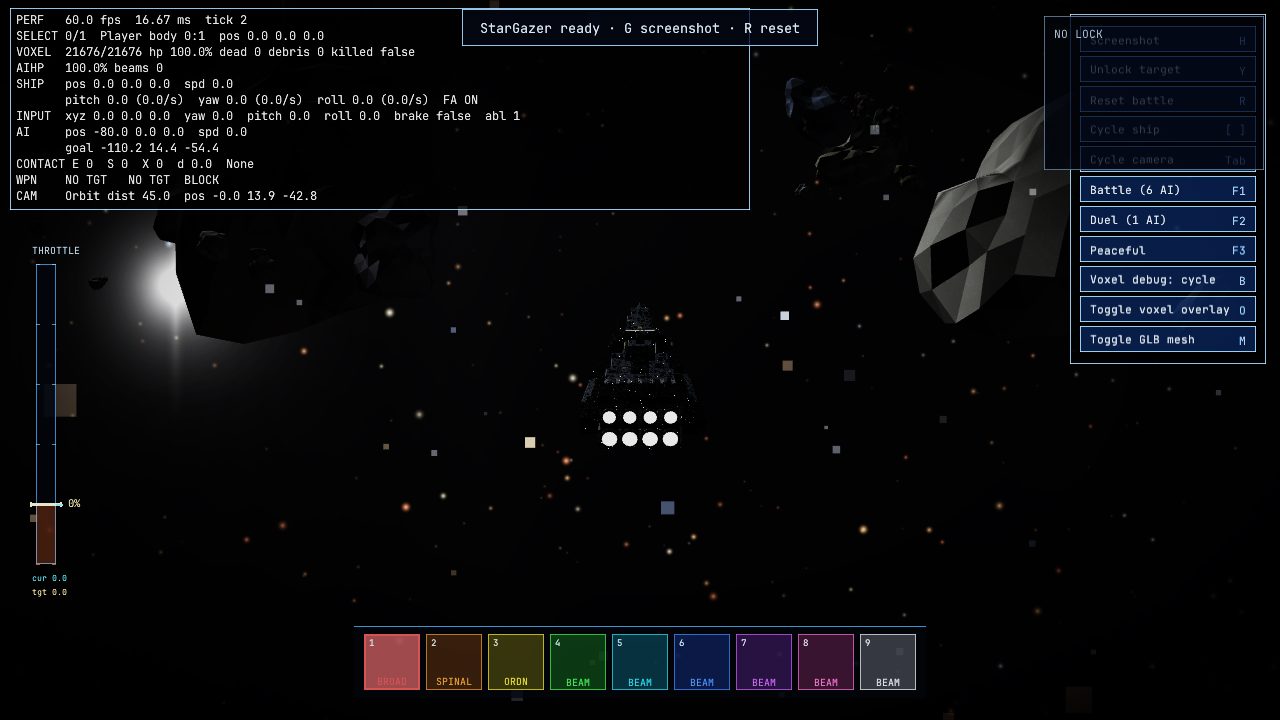 After. Same ship, lit honestly. The hull reads. You can tell which side is forward without squinting.
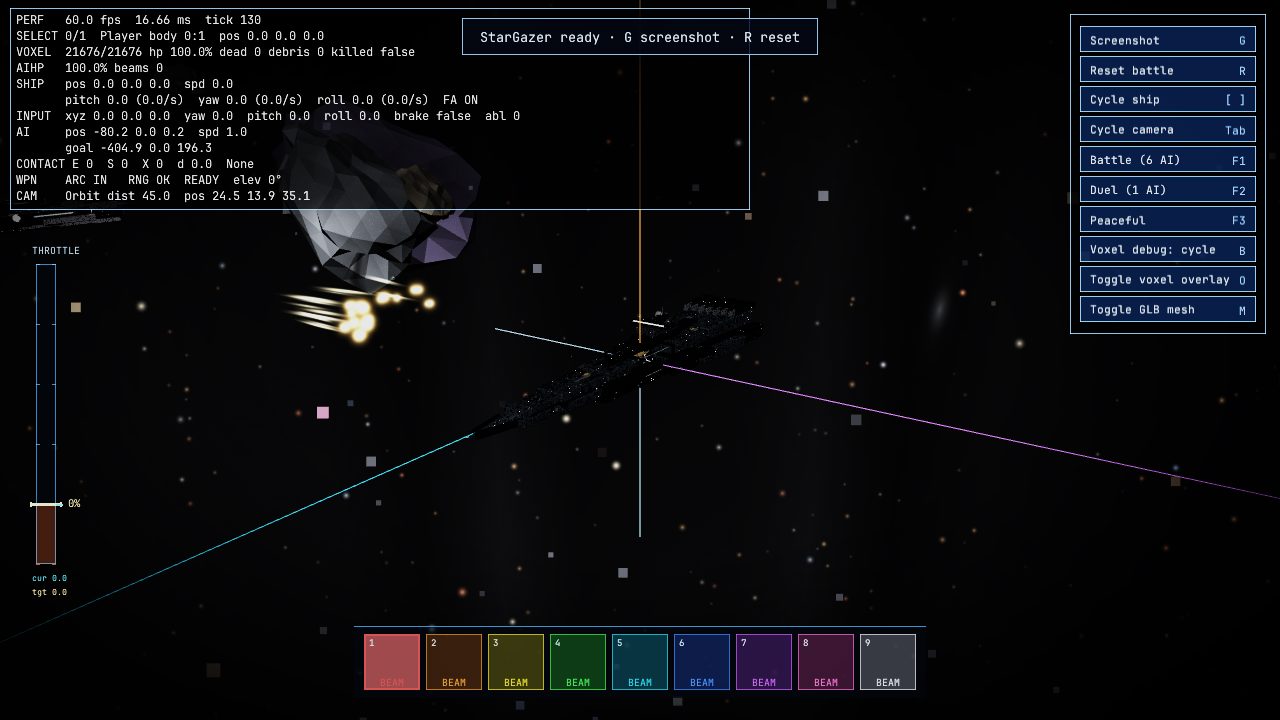 Real shells, finally. Heavy slugs leaving the broadside racks and traveling, instead of an instant beam pretending to be combat. You can lead a shot now.
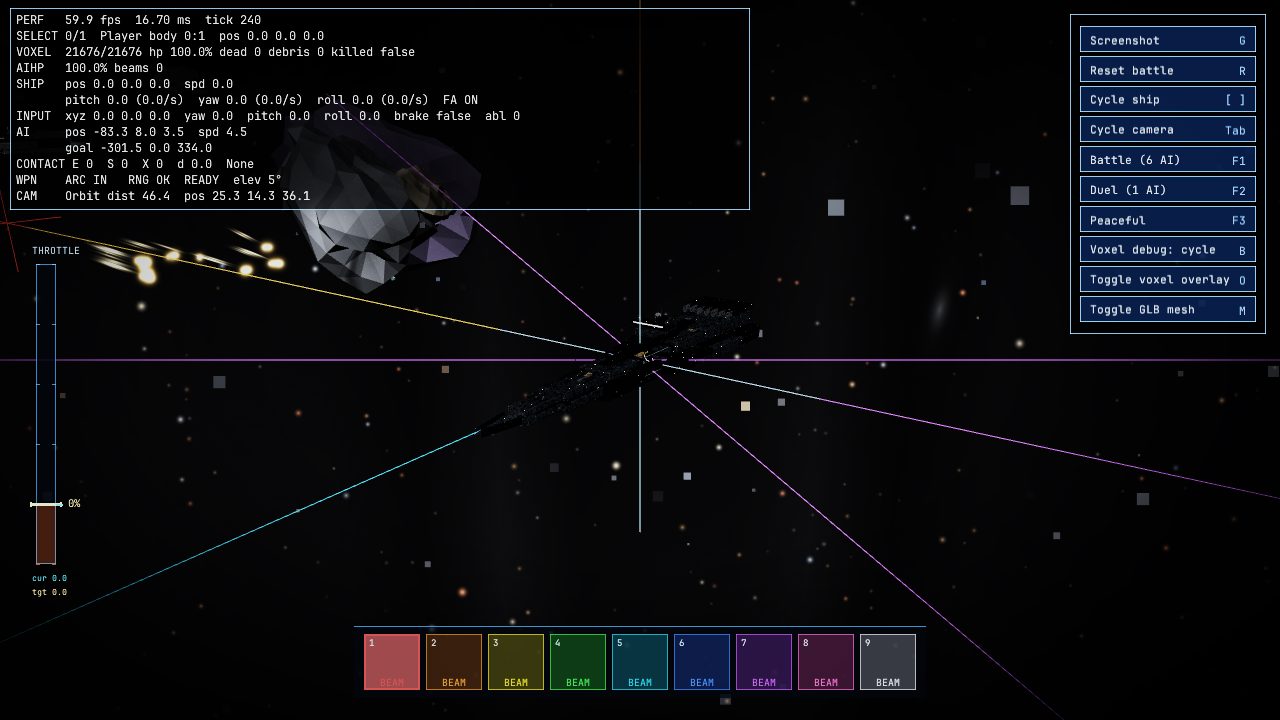 Point defense, doing its job. A swarm of inbound rounds meeting a curtain of small fire from the hull. The first time a shot of mine got eaten on the way in, I laughed.
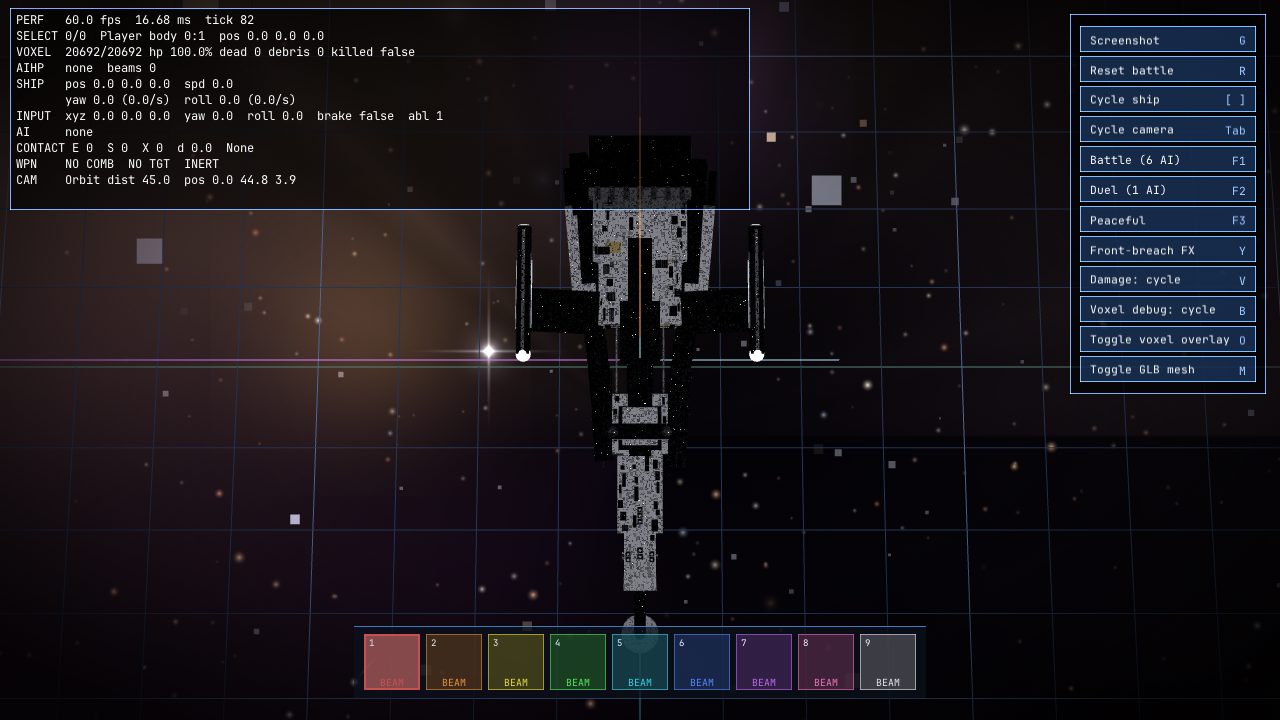 Eight ships, eight silhouettes. A sweep across the fleet under the new light. Every hull a different face, every face legible at a glance.
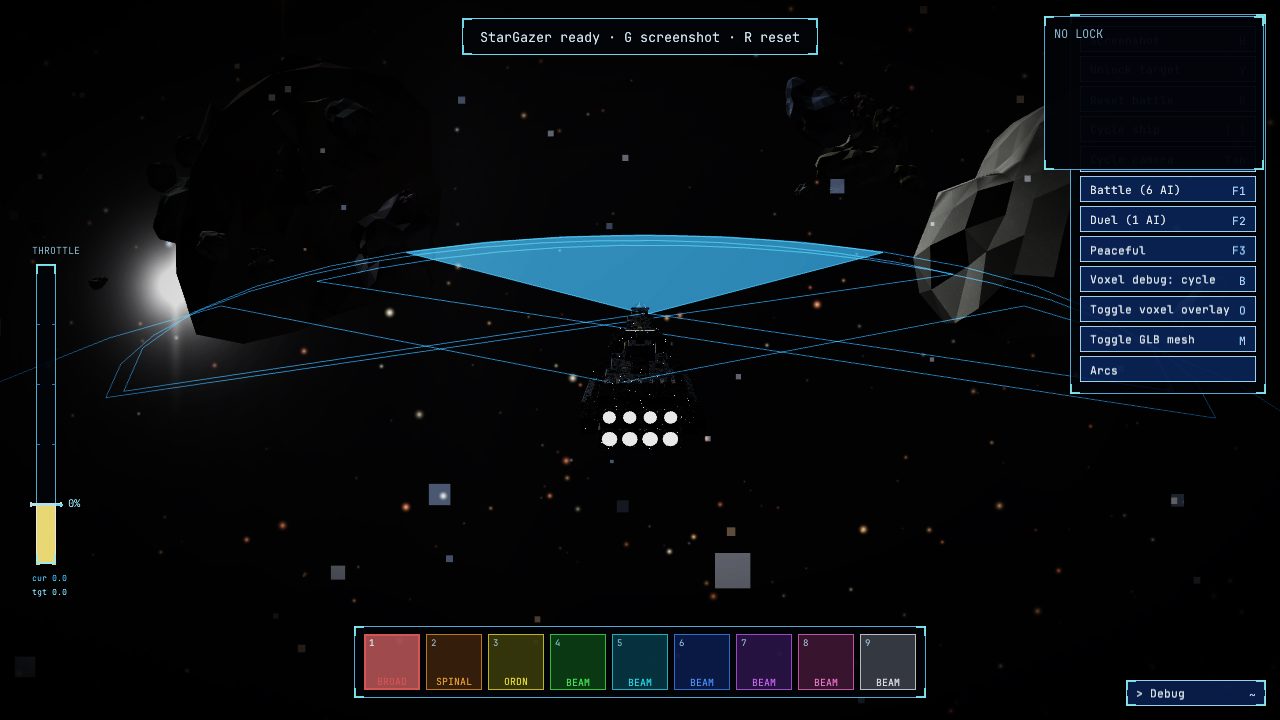 The cockpit, cleaned up. The diagnostics that used to crowd the top of the screen now live in a quiet corner, ready when I want them, gone when I don't.
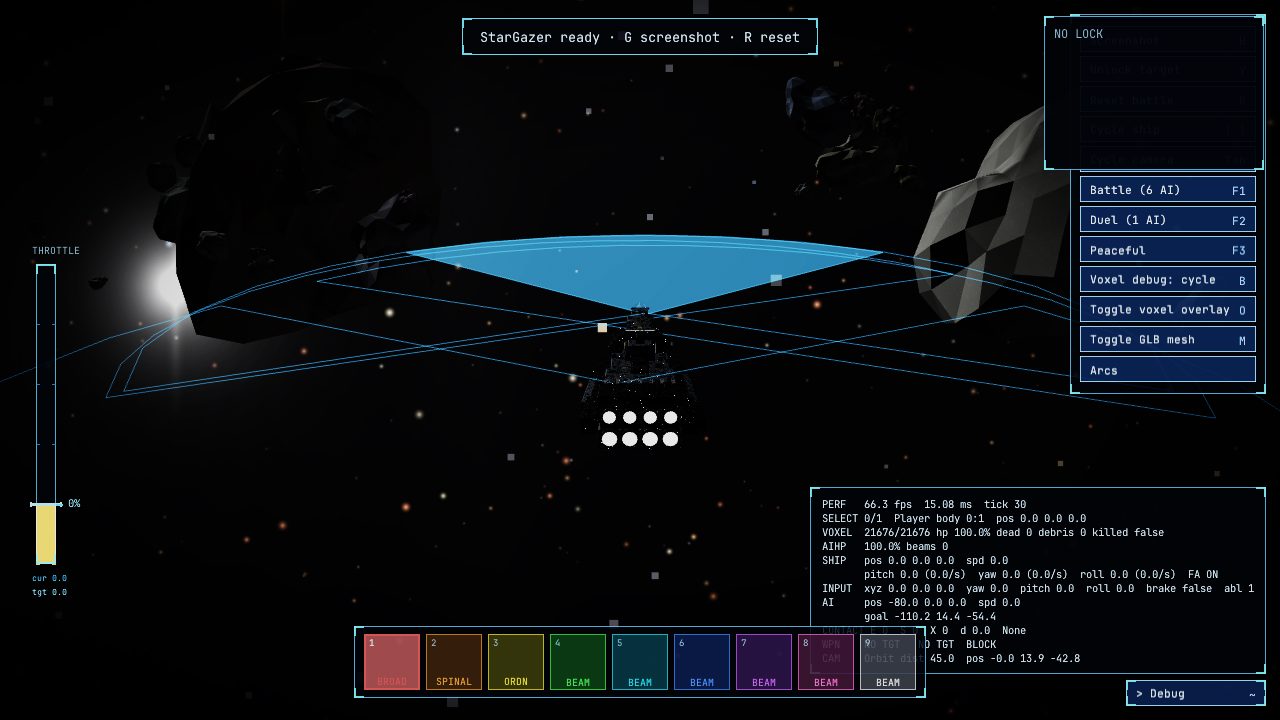 The same cockpit, open for business. One click and the readouts unfold upward, an instrument panel only when you ask for one.
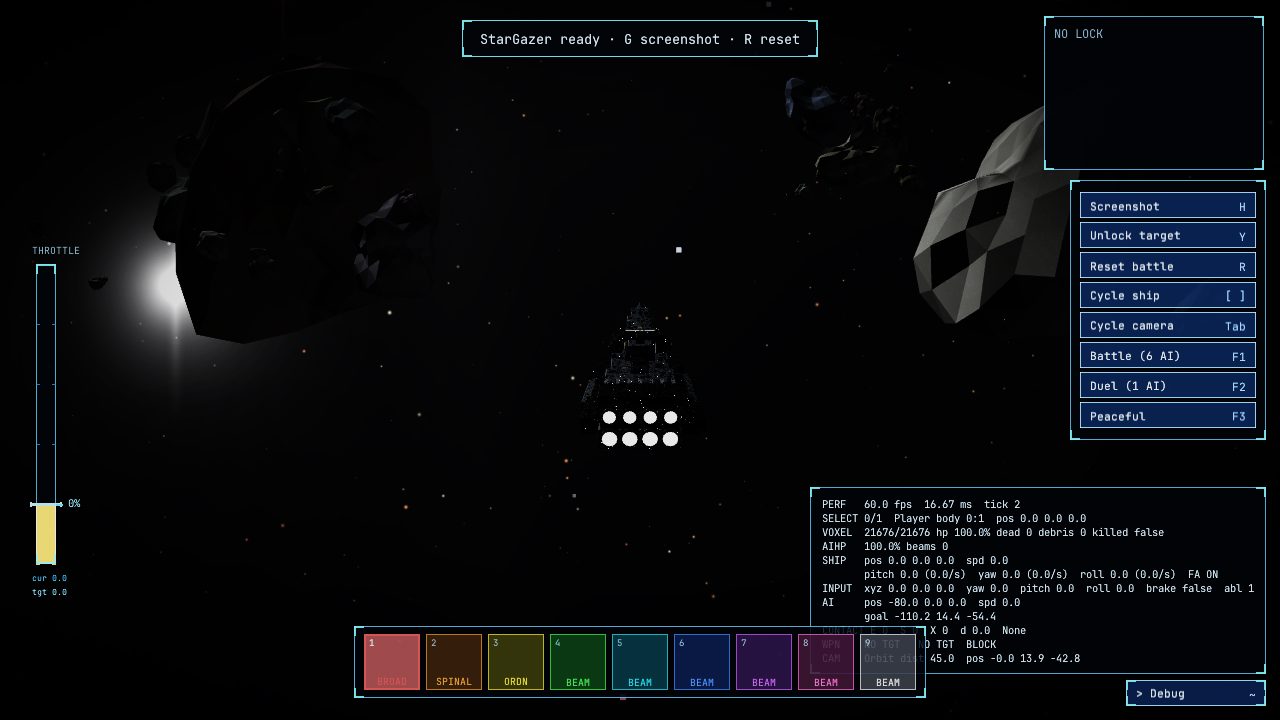 What it all adds up to. End of the run, lights dialed, motes quieted, stars at half size: the picture I want a stranger to see first.
Retrospective
Five days ago this was a vehicle with a steering wheel and a cheat-beam. Tonight it is a ship I want to take out into the dark. Not all of it landed. Some of it had to be torn out and rebuilt under a cleaner light, and the bruise on my pride from a whole evening of flying a mirror image of my own ship has not quite faded. But when I close the lid on the laptop and the last frame I saw is a hundred-meter hull leaning into a turn against a near-black sky with a clean white sun raking the bow, I know what I am building. Sit in the chair. Pick a star. Commit.