Singularity Forge: The Reactor Core Your Capital Ship Is Built Around
Every capital ship now carries a hex-paneled, multi-banded containment cell at its centreline — a deliberately exposed kill-target the rest of the hull defends.
Singularity Forge: The Reactor Core Your Capital Ship Is Built Around
Dev Log
- One canonical core, every ship. All capital ship classes now carry the same recognisable reactor — a hex-paneled containment cell ringed by five structural bands. Only the size changes; the silhouette is shared.
- Built around the core, not stuck on top of it. The reactor sits dead-centre on the hull's midline inside a carved chamber. The rest of the ship genuinely wraps around it.
- Diameter capped at twenty percent of the ship's longest dimension. No more orbs out of proportion to the hull they sit in.
- A gameplay-defining kill target. The chamber is open top, bottom, and broadside on purpose — the core is supposed to be a vulnerable, valuable target you defend.
- Six ship families × five camera angles, reviewed by a fleet of agents. Three render iterations driven by parallel visual reviewers until the design read correctly on every ship.
Why a single core silhouette
The reactor is the most important thing on a capital ship — it powers everything and, if it dies, the ship dies with it. That meant two things at once:
- Every ship in the fleet needed to read the core the same way so players learn one silhouette and recognise it across enemy hulls.
- The core had to be a target you could actually fight over — exposed enough to shoot, surrounded by enough structure that a competent commander can keep it alive.
Earlier passes had four different reactor styles per ship class; players had to learn four shapes that all meant "the same thing." That's now collapsed into a single canonical design that scales with the ship.
Anatomy of the containment cell
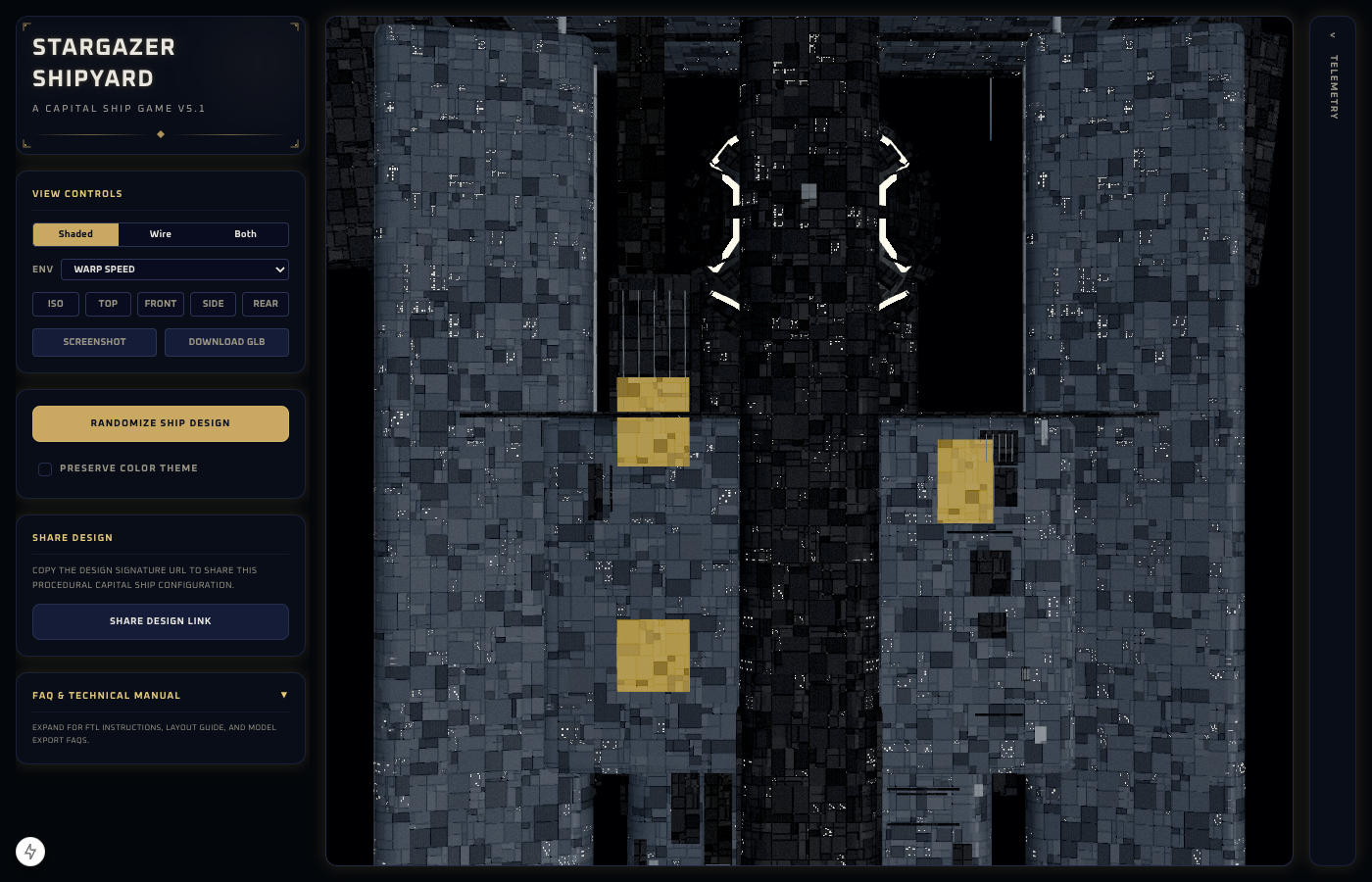
The dreadnought's reactor seen from directly above. Five containment bands ring a hexagon-paneled shell, with the warm gold seam-glow tracing every panel edge.
The core itself is a metallic shell clad in twelve dark hexagonal panels arranged in a soccer-ball pattern. Between every panel, a thin emissive gasket glows warm gold — that's the structural seam light. Inside the shell, a cool blue singularity throws subtle light through the gaps without saturating the frame to white.
Wrapping the shell are five containment bands:
- an equatorial belt,
- two latitude bands at thirty-eight degrees north and south,
- and two orthogonal meridian rings.
The bands silhouette as dark ribs against the metallic shell, reading clearly even at silhouette distance.
Sized to its host
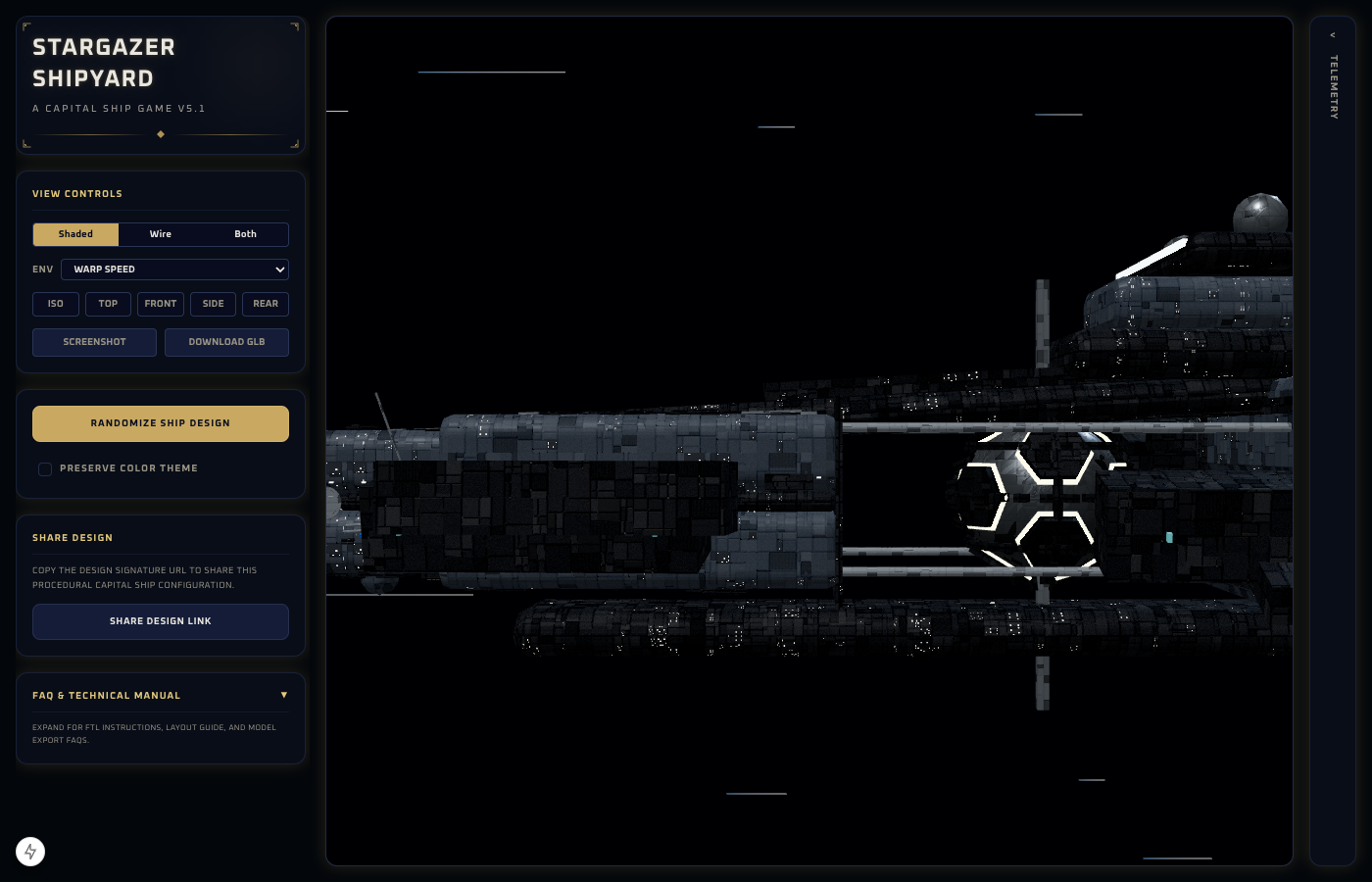 A wedge-capital seen broadside. The reactor is the bright spot dead-centre of the hull — proportional, prominent, framed by the carved chamber gap.
Across every ship family, the core's diameter is bounded by twenty percent of the ship's longest dimension and clamped to fit inside the local hull cross-section. The default growth curve sits comfortably below the cap so cruisers and dreadnoughts get bigger cores than gunships, but no ship ever gets a core that overflows its silhouette.
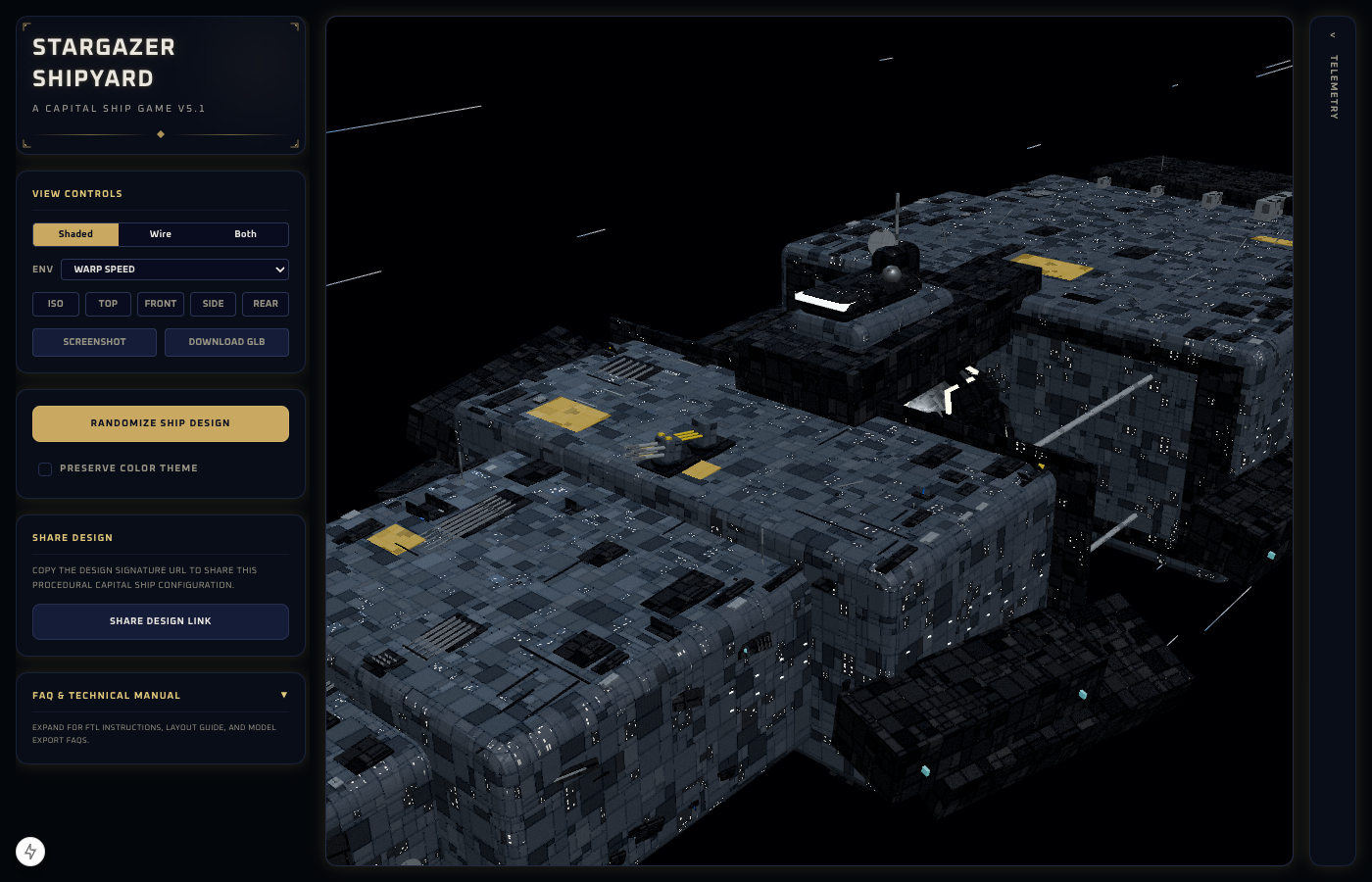 The frigate's smaller hull carries a smaller core, but the proportions and the cladding pattern are identical to the dreadnought's.
Centered in the gap, not perched above
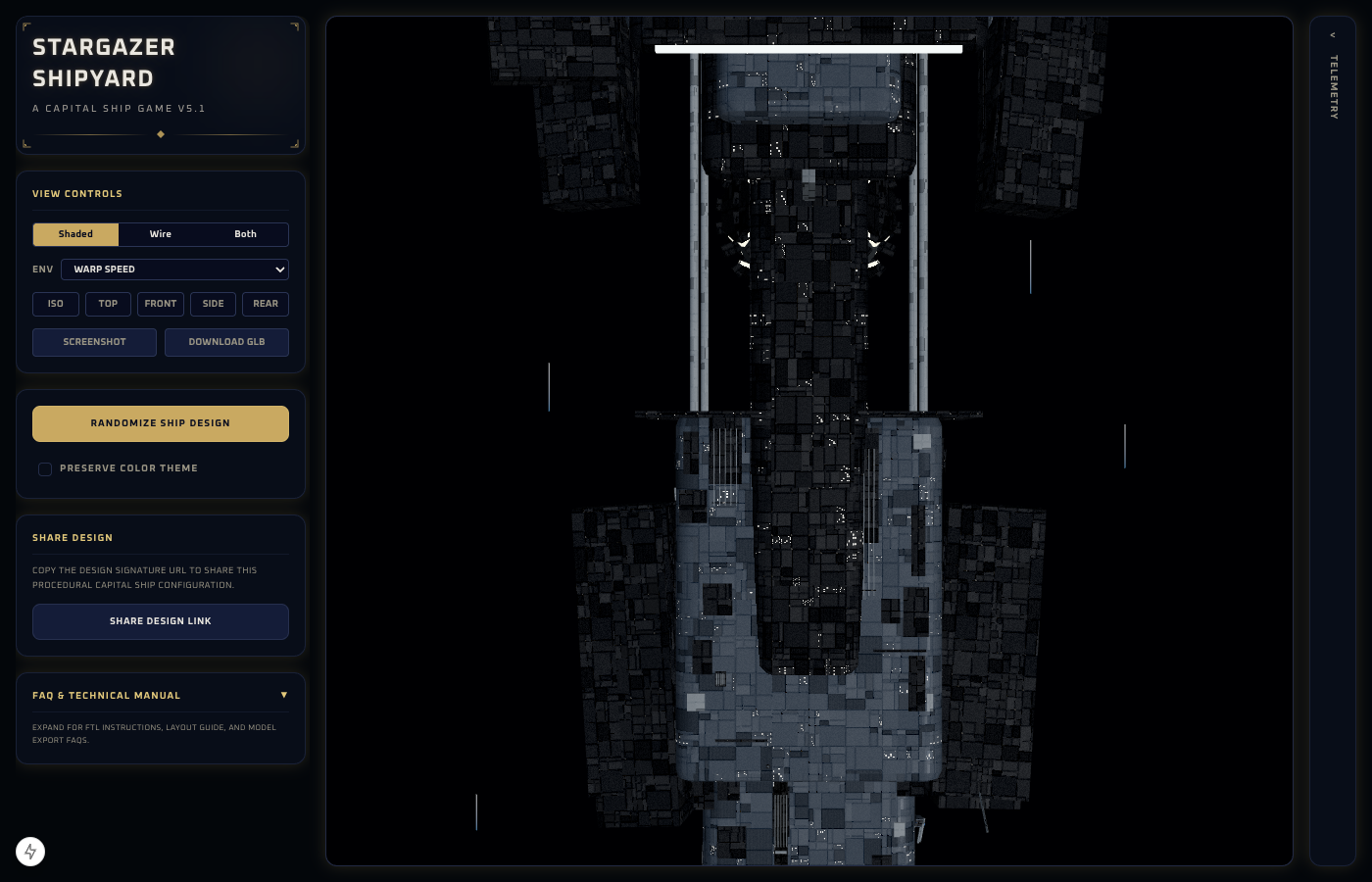 Top-down on a wedge-capital. The hull explicitly carves a chamber for the reactor; the core sits inside that carve, framed by structural rib cages fore and aft.
A previous pass had the core floating just above the dorsal hull — visible, but it didn't read as "the heart of the ship." This pass anchors the sphere on the hull's midline so the silhouette wraps around it instead of just topping it. The carved chamber leaves the core's top, bottom, and both broadside arcs open, giving attackers a clean shot and defenders something real to position around.
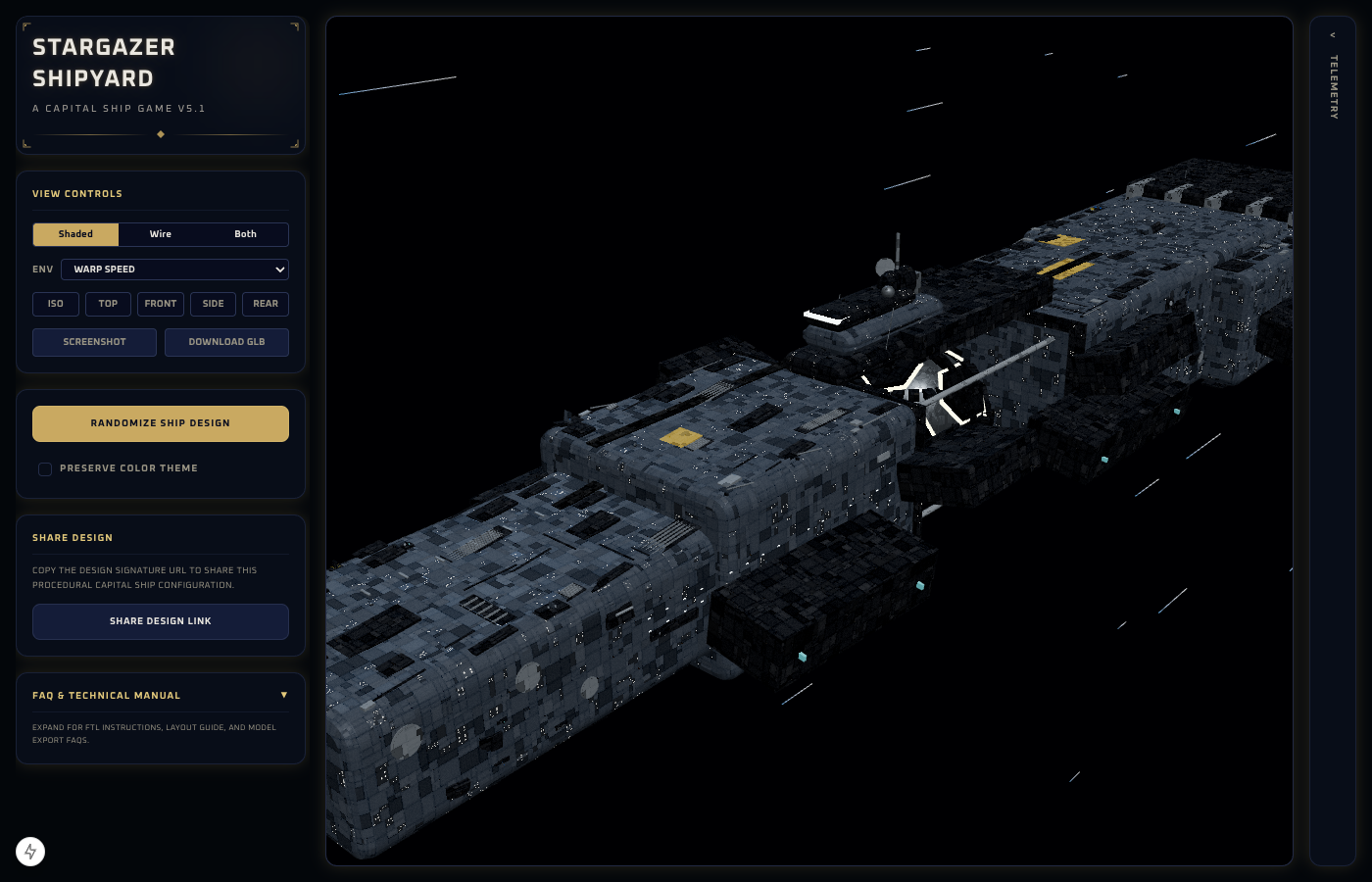 Carrier-spine variant. Same core; the wider, longer hull just lets the chamber breathe more.
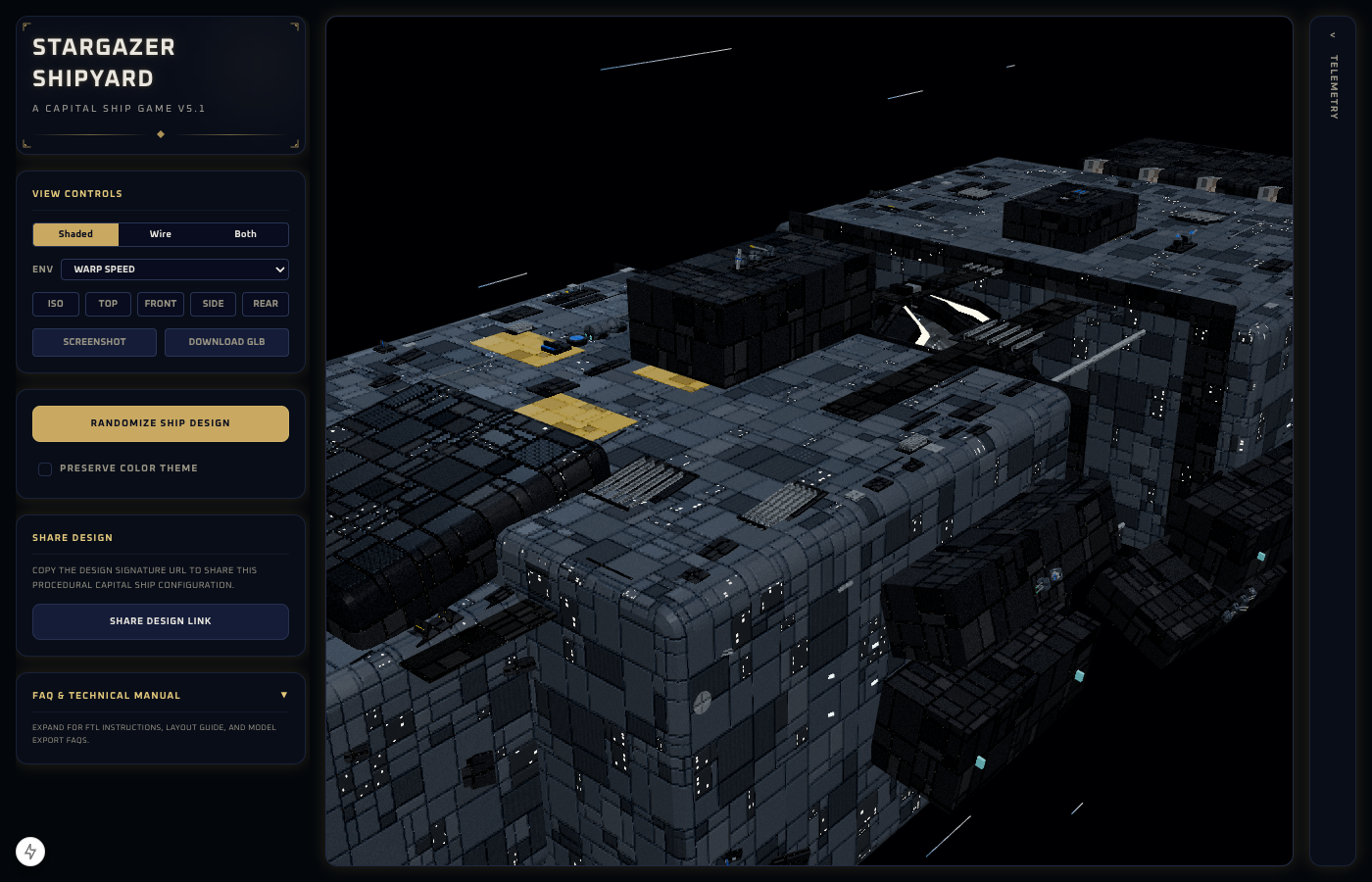 Utility shuttles get the smallest core. Even at this scale you can still pick out the hex panels and the gold seam-light.
How the design landed
The first cut of the unified reactor was a too-bright white orb perched on top of the hull. The second cut was a too-dark sphere that camouflaged against dark-hulled ships. The third cut — the one shipping now — inverts the contrast: a bright metallic shell with dark hex panels and dark bands silhouetting on top of it, plus warm gold trim at every panel seam to keep the surface from ever reading as flat colour.
Each cut was rendered against all six ship families from five camera angles, and a parallel fleet of reviewer agents read the images and reported what was working, what wasn't, and what to try next. That cadence — generate, review across the whole fleet, adjust, generate again — got the design from "where did the core go?" to "instantly recognisable on every ship" in a single afternoon.
Retrospective
- One silhouette beats four. Players will learn the reactor shape once and use that knowledge against every enemy in the fleet.
- Exposure is a feature, not a bug. The reactor is supposed to be a kill-target. The hull's job is to make it expensive to reach, not to hide it.
- Inverted contrast saved the read. Bright shell with dark cladding silhouettes the panel pattern at every zoom; the opposite never did.
- Parallel visual review compresses iteration time. Running six families × five angles through a panel of reviewers in one shot caught issues a single eye would have missed on a single render.